A wine can tell us many things. About poor soil where roots had to learn to fend for themselves, an overly dry summer, an early harvest or a family that has spent generations determined to preserve a few vines that may have seemed to have no future.
But before all that comes the grape.
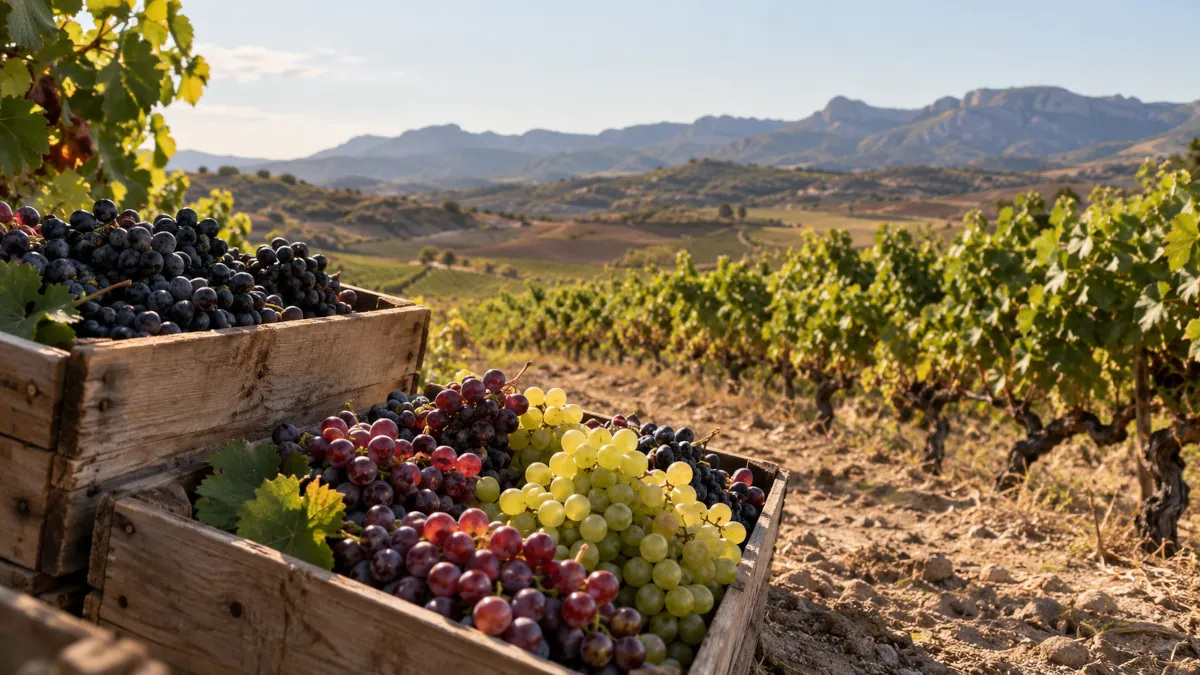
Tempranillo, garnacha, albariño, verdejo, mencía, bobal, monastrell… Names we find so often on a label that we risk forgetting that each one has an identity behind it. And often a territory that would be difficult to imagine without it.
Spain possesses an extraordinary diversity of grape varieties. Some cover thousands of hectares and have become true international ambassadors. Others survive in small plots thanks to winegrowers who refused to pull them up when planting something else seemed more profitable.
That is where much of the magic lies.
Because understanding Spanish grape varieties is also a way of understanding why our wines taste of the places they come from.
Spanish grape varieties: when the landscape ends up in the glass
It would be convenient to divide them simply into red and white grape varieties. Neat, classified and perfectly arranged in two columns.
But wine is rarely that simple.
The same grape can yield completely different results depending on where it grows. Soil, altitude, aspect, available water, the age of the vine and the temperatures it withstands during summer all change.
And so does the person behind it.
Garnacha growing in an old vineyard in Aragon does not have to resemble garnacha grown on the slopes of Gredos. They share genetics, but not necessarily character.
We were able to see this at Madrid Fusión, when several Aragonese garnachas showed that a variety can sometimes hold many personalities beneath the same skin: red fruit, flowers, wild-herb notes, freshness, power and mineral nuances appeared differently in every glass.
One protagonist. Different stories.
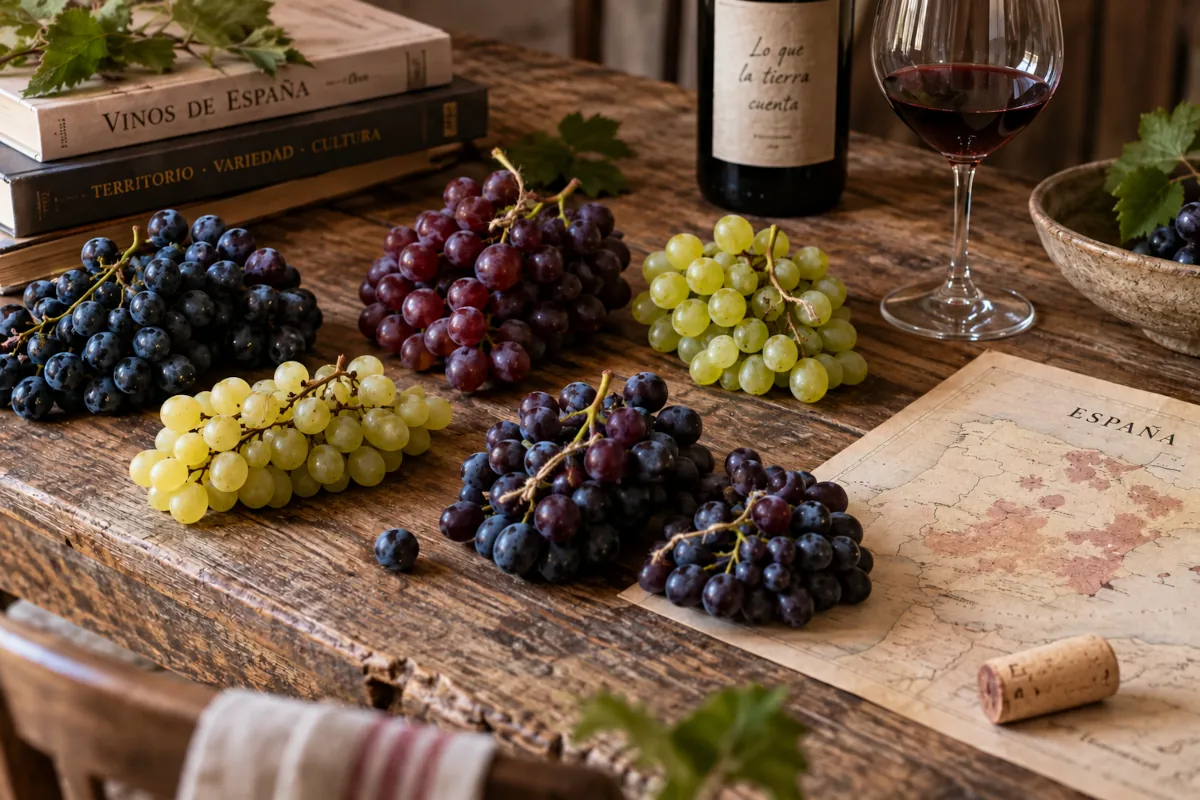
Tempranillo: the variety that learned to speak many languages
Few Spanish grapes probably have as many names as tempranillo.
Tempranillo in Rioja. Tinto fino or tinta del país in Ribera del Duero. Cencibel in Castilla-La Mancha. Ull de llebre in Catalonia.
It is not simply a linguistic curiosity. It is an excellent clue as to how deeply this variety has integrated into different territories.
It remains the winemaking variety with the largest planted area in Spain. The latest figures published by the Ministry of Agriculture place it ahead of airén, with both far ahead of the rest.
In Rioja it is one of the pillars of the identity of its reds. There it can show aromas of red and black fruit, floral notes and a gentle texture in youth; with time and ageing, nuances of vanilla, cocoa, coconut or liquorice emerge.
But perhaps the truly interesting thing about tempranillo is its ability to change outfits without ceasing to be recognisable.
It can produce a young, direct wine or wait patiently for years.
Not all grapes know how to age with such elegance.
Garnacha: a survivor that became a treasure again
Some varieties seem to need to disappear a little before we rediscover them.
For decades, garnacha was often associated with high-alcohol, concentrated wines and a certain rusticity. It was hardy, productive and always there. Paradoxically, that did not always help it gain the prestige it deserved.
Today the story is very different.
Garnacha has become one of the most exciting varieties in the Spanish wine scene, especially when it comes from old vineyards, poor soils and high-altitude areas.
Aragon has an especially strong historical connection to it, but Navarre, Catalonia, Rioja and Madrid have also found different ways to interpret it.
In the glass it can be generous and fruity, but also delicate, floral and surprisingly fresh. Some garnachas arrive in a powerful voice, while others almost whisper.
That is its uniqueness. It does not impose a single style. It allows itself to be shaped by the territory.
And that is probably why it is also one of the varieties that best explains one of the great transformations in Spanish wine in recent years: the recovery of old vineyards and identities that remained in the background for far too long.
Albariño: the Atlantic turned into wine
There are wines that almost seem to bring with them the climate of the place where they were born. With albariño, it is hard not to think of Galicia: humidity, intense greens, stone, estuaries and an Atlantic that can be beautiful and unforgiving on the same day.
Especially linked to Rías Baixas, this white variety has a highly recognisable aromatic identity and an acidity capable of holding the wine together with precision.
Citrus, stone fruit, flowers, white fruit… Its nuances can vary, but there is almost always a sense of freshness that immediately makes us think of the table.
Shellfish, fish, rice dishes and simple preparations where the product is the star.
It is no coincidence. Great wines usually understand very well where they come from.
Verdejo: the Castilian character that hid more than one side
At first glance, the Castilian plateau does not seem the most delicate setting. Cold winters, dry summers, wide temperature swings and soils where survival requires a certain discipline.
Verdejo has been doing so in Rueda for more than ten centuries. The denomination itself considers it its native variety and highlights its notes of low scrub, fruit and a very distinctive acidity.
For a long time, for some consumers, verdejo was almost synonymous with young white wine: fresh, aromatic and easy to drink.
But that was only a very small snapshot.
Handled with ambition, it can offer wines with more body, texture and complexity, lees ageing or styles capable of evolving for years.
Sometimes the real treasure is not discovering something new, but looking more closely at what we thought we already knew.
Airén: the silent giant
If we spoke only of recognition, airén would probably occupy a rather discreet place. But if we speak of vineyards, the story changes completely.
With more than 180,000 hectares planted, it remains Spain’s leading white variety by area and represents approximately 43% of the vineyard devoted to white varieties.
For decades it was associated with high yields and simple wines, especially in Castilla-La Mancha. Yet it is becoming increasingly interesting to follow producers who have turned their attention back to old airén plots and chosen to treat them with a different sensitivity.
Lower yields. More attention to the vineyard. Careful winemaking… And suddenly another airén appears. One that was there all along.
Bobal, monastrell and mencía: when a variety tells the story of its territory
The map of Spanish wine grape types is full of almost sentimental connections between a variety and a place.
Bobal takes us to Utiel-Requena and Manchuela, where for years it was valued above all for its resilience, colour and productivity. Today there are projects able to draw wines of great freshness and personality from it.
Monastrell has the Mediterranean in its veins. Murcia, Alicante and other eastern areas are its natural territory. Sun, drought and high temperatures do not seem to frighten it much.
And mencía, particularly linked to Bierzo and other north-western regions, can offer fragrant, fresh reds with red fruit, flowers and a delicacy that bears little relation to the stereotype of powerful, ripe Spanish wine.
Three varieties. Three completely different landscapes. That is precisely what is so fascinating.
Godello and other white grape varieties worth following
For years, when people spoke of great Spanish whites, it seemed they first had to justify that Spain could make them too. Fortunately, that conversation is changing.
Godello, particularly in Valdeorras and other north-western areas, has shown a remarkable ability to produce wines with volume, minerality, freshness and interesting evolution in bottle.
It is joined by varieties such as treixadura, xarel·lo, macabeo or viura and palomino fino, each linked to very different geographies, styles and traditions. And there are still many more.
Some occupy only a few hectares. Small survivors in a vineyard that for decades tended to become uniform. And precisely for that reason, they matter.
What is the best Spanish grape variety?
It is probably one of those questions that does not deserve an answer.
Best for what? To accompany fish? To wait ten years in a cellar? To drink lightly chilled during a summer lunch? To go with a winter stew?
Tempranillo has depth and an extraordinary capacity for ageing. Garnacha can move us with its finesse and ability to convey the landscape. Albariño and verdejo show two completely different ways of understanding a white wine. Bobal, mencía and monastrell champion territories that, for a long time, did not always receive the attention they deserved.
Choosing only one would mean missing too much.
Perhaps it is much more fun to do the opposite.
Choose a variety, taste it in different regions, compare a young vine with an old one, or discover how two winemakers interpret the very same vineyard in completely different ways.
That is where we begin to understand wine for real.
The real luxury lies in diversity
Spain preserves one of the world’s most interesting wine-growing heritages. Its most widespread varieties live alongside small local grapes, centenary vines and vineyards that have survived because someone decided they were worth preserving.
They are not merely raw material. They are memory.
Every variety contains part of the history of those who cultivated it, the climate it had to adapt to and the territory it ultimately made its own.
That is why, next time we have a bottle in front of us, it may be worth pausing for a moment before pouring it. Looking at the label, finding the name of the grape and asking ourselves where it comes from.
Because very often, that is exactly where the journey begins.